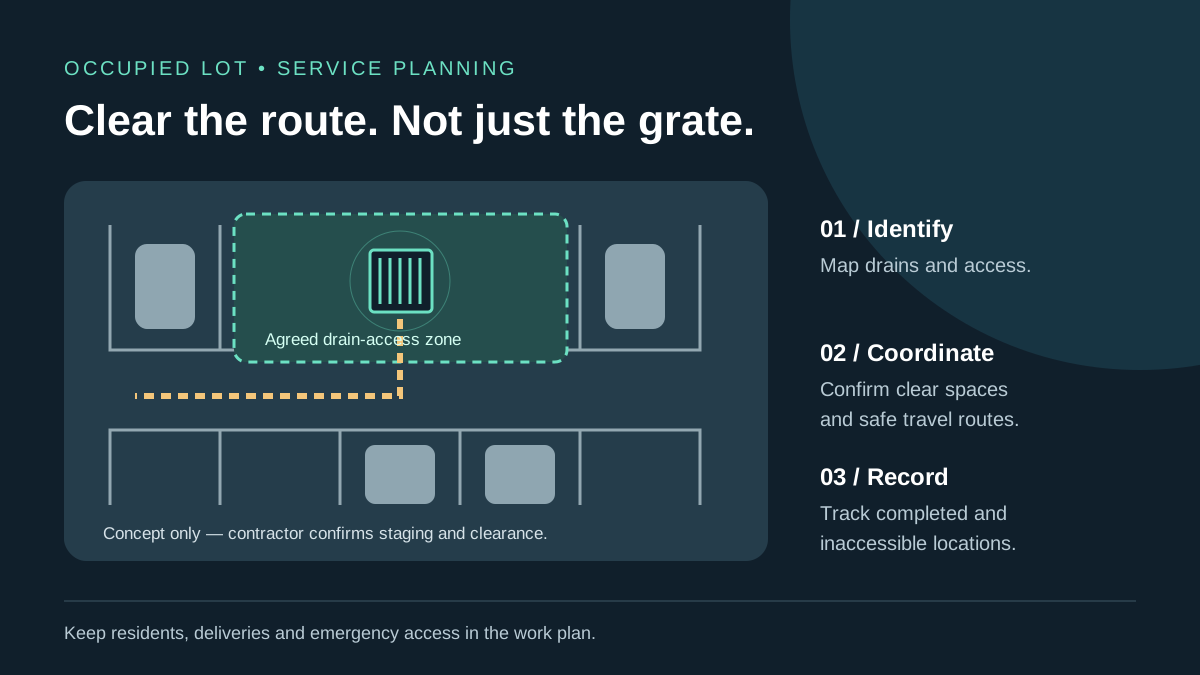
A service booking is also an access plan
For an occupied Lower Mainland strata or commercial parking lot, booking catch basin cleaning involves more than choosing a date. Vehicles can cover grates, block the route to a drain or leave nowhere suitable to stage equipment. A clear grate alone does not establish that work can proceed safely around pedestrians and moving traffic.
During fall leaf drop, it is worth resolving those access details before the next maintenance visit. The City of Coquitlam's flood protection guidance recommends keeping catch basins clear of leaves and debris. It also distinguishes blocked pipes from rainfall exceeding drainage capacity. This access checklist helps arrange cleaning; it does not promise that cleaning will prevent every flood.
1. Identify the drains—not just the parking stalls
Use an existing site plan or a simple marked overview to identify the private drains included in the request. Give each visible location a reference such as “Basin A, visitor parking entrance.” Note which drains are under parked vehicles, behind a gate or beside a busy walkway. A parking-space number alone may not make the drain easy to find.
- Approximate catch basin and trench drain counts, with unknown counts clearly labelled.
- Parking, loading and pedestrian routes near each location.
- Known height restrictions, ramps, tight turns or weight restrictions for contractor assessment.
- Any repeated pooling, slow drainage or previously inaccessible locations.
- A safe place for the contractor to assess staging, without assuming equipment dimensions or reach.
Photograph visible locations only from a safe, dry position. Avoid identifiable people, licence plates and entry credentials. Do not lift a grate, crawl under a vehicle or enter pooled water to complete the plan. For underground access, use the parkade service-request checklist as well; low-clearance equipment availability must be confirmed.
2. Ask the provider to define the clearance zone
There is no reliable universal number of parking spaces to clear for every catch basin. The work method, equipment position, hose route, traffic and drain location all matter. Before issuing a notice, ask the provider to identify the required work zone and whether a preliminary site assessment is needed.
A hose route should not be improvised through occupied stalls or across an unprotected pedestrian path. Confirm how residents, customers and deliveries will move around the work, who will manage barriers or traffic arrangements, and whether a route must close temporarily. Keep emergency access available under the agreed site plan.
Do not promise that the contractor can work around a vehicle parked directly over a drain. If a location cannot be reached, the choices may include rescheduling that portion or arranging another authorized access window. Agree how incomplete work and any return visit would be recorded and quoted.
3. Choose whole-lot or phased access deliberately
A single access window
Where the site can release the required spaces together, one coordinated window can simplify communication and basin tracking. Confirm the actual arrival window, anticipated disruption and the contact responsible for checking access. A requested date is not a confirmed appointment.
Work by parking zone
At an occupied strata or retail property, phased access may be worth discussing. For example, one zone could remain available while another is serviced. The provider must confirm whether repeated setup, connecting pipe work and traffic movement make that approach practical. Phasing is not automatically cheaper or feasible.
If hydro jetting or camera inspection is planned, the required access may extend beyond the basin being vacuumed. Ask which other structures or cleanouts need to remain reachable before finalizing the sequence.
4. Send a useful resident or tenant notice
Once the work window and zones are confirmed, the authorized property manager should communicate the parking restrictions through the property's normal channels. Give enough detail to avoid residents moving a vehicle from one work zone into another.
- Purpose: private catch basin or storm drain maintenance.
- Confirmed window: the date and the period when identified spaces or routes must remain clear.
- Affected locations: a simple map or clearly marked zones, including any visitor or loading spaces.
- Access arrangements: the approved alternative route or parking instructions, if available.
- Questions: the property-management contact who can resolve access issues.
- Changes: how residents will receive updates if weather, safety conditions or access change the plan.
Use the property's applicable rules and authorized procedures for any parking enforcement; this guide does not establish towing authority or a notice period. Do not publish gate codes in a general notice or enter them in the initial website enquiry. Arrange sensitive access instructions securely during follow-up.
5. Confirm scope before the truck arrives
Parking coordination should not obscure what was actually ordered. Basin vacuum cleaning and connected-pipe cleaning are different services. Ask which structures are included, whether line work is included, and who may authorize additional work if a restriction or defect is found.
On the service day, have an authorized site contact available to resolve access questions. Do not ask staff or residents to move barriers, lift covers or approach operating equipment. If vehicles still obstruct a location, tell the contractor and let the authorized manager arrange access rather than improvising an unsafe workaround.
6. Close the loop on any skipped drains
Ask for a record that distinguishes completed basins from inaccessible or deferred locations. “Site serviced” should not be interpreted as “every drain completed” unless the actual record supports that conclusion.
- Identify each serviced structure using the same map references.
- Record locations not reached and the reason, without unnecessary resident information.
- Separate completed basin cleaning from jetting, inspection or proposed repairs.
- Confirm whether a return visit is needed and what access must change.
- Keep safe surface observations of later pooling with the service record; do not treat them as a diagnosis.
The commercial storm-drain maintenance record can organize this handover. For ongoing contracts, include access responsibilities in the maintenance scope so the same blocked locations do not disappear from the next visit.
Common parking-access questions
Does every car have to leave?
Not necessarily. Clear the locations and routes specified in the agreed access plan. The provider must confirm whether working in phases around other parked vehicles is suitable for your site.
Can a longer hose solve the access problem?
Not automatically. Reach is only one consideration. The drain itself, safe staging, hose routing, pedestrians and traffic still need assessment. Do not book on an assumed hose length.
What if water is already rising?
Keep people away from floodwater and electrical hazards, and call to discuss current service availability and safe access. Do not wait for a routine parking notice if immediate safety is at risk. Contact emergency services for immediate danger; municipal infrastructure concerns belong with the relevant city. See the active parking-lot flooding guide.
Plan access before booking
Need catch basin cleaning in an occupied parking lot?
Tell Lowermainland Catch Basin Service the city, approximate drain count, affected parking zones and preferred window. We can discuss access and service scope in Port Coquitlam, Coquitlam, Burnaby, New Westminster and other listed Lower Mainland areas. Equipment suitability, scheduling and any staged work require confirmation.