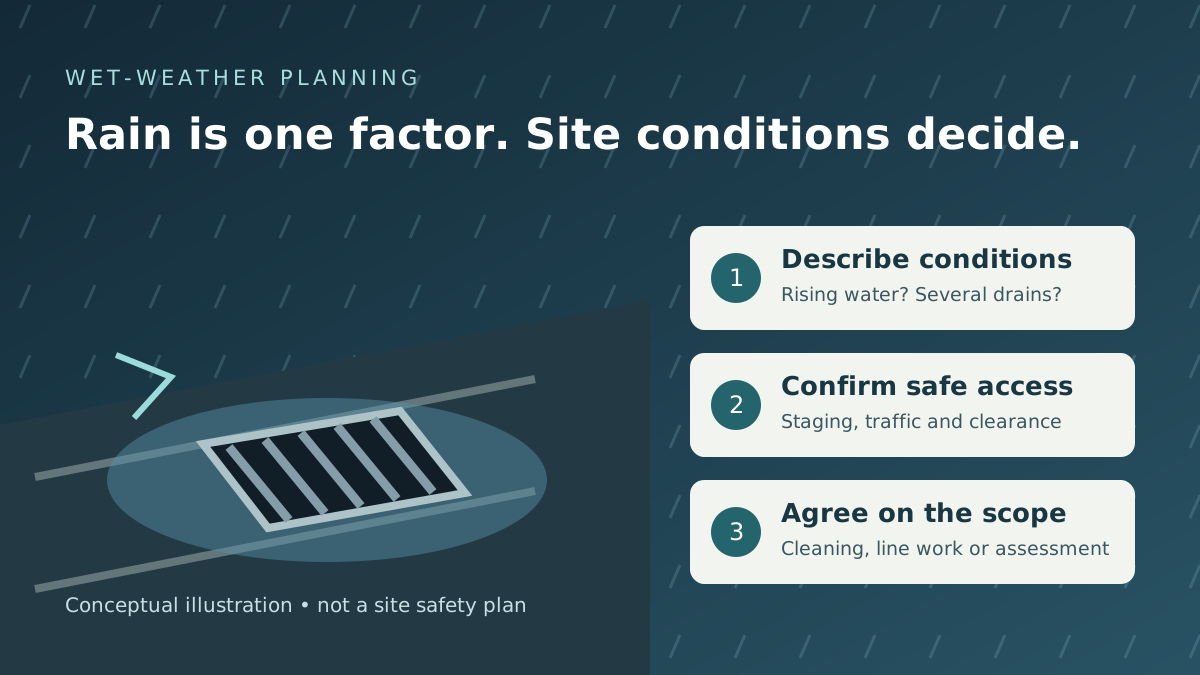
Should you book now or wait until it stops raining?
For a private parking lot or strata property with recurring pooling, start the conversation now. Waiting for dry weather can leave the same unresolved problem in place for the next rain. A scheduled visit may still need to be adjusted if water rises, visibility deteriorates or the crew cannot establish a safe work area.
If water is actively threatening an entrance, loading bay or parkade, phone rather than relying on a routine web form. Describe the risk and ask about response availability; do not assume immediate attendance. Keep people away from floodwater, electrical hazards and unsafe vehicle routes. Contact emergency services if people are in immediate danger.
For drains that are working but due for maintenance, arrange a planned service window. The City of Coquitlam's flood protection guidance recommends keeping catch basins clear of leaves and debris and raking leaves in fall. It also explains that flooding can result from blocked pipes or rainfall exceeding drainage-system capacity. This is seasonal guidance, not a current weather alert or a promise that cleaning prevents all flooding.
What can change the rain-day cleaning plan?
Water covers the drain or its surroundings
A crew needs to identify the structure and assess access without putting people into hidden hazards. Deep or moving water can obscure grate edges, holes and damaged pavement. Do not walk into pooled water to find a drain, lift a grate, or enter a catch basin. A safer assessment or a later work window may be necessary.
The truck cannot reach a suitable position
Parked vehicles, delivery queues, steep ramps, restricted clearances and soft ground can affect where equipment can operate. Give the provider the actual approach and staging constraints. Do not promise that a hose can reach every basin or that a truck can enter a parkade; the provider must confirm equipment suitability.
The problem extends beyond material inside the basin
Catch basin cleaning removes accumulated material from the structure. It does not automatically clear the full connected storm line or fix a downstream capacity problem. If several drains rise together or the site repeatedly floods after cleaning, ask for assessment rather than ordering the same task without reviewing the previous findings.
Cleaning, jetting or camera inspection during wet weather?
Describe what you see; you do not need to select the equipment yourself. The useful distinction is between sediment in a basin, a restricted pipe and a condition that cleaning cannot resolve.
- Basin sediment or debris: discuss vacuum cleaning of the affected structures, with safe access and material handling included in the scope.
- Suspected pipe restriction: hydro jetting or line flushing may be suitable after assessing the pipe, obstruction and access. It is not a substitute for repairing damaged pipe.
- Recurring or unclear symptoms: camera inspection can help assess accessible pipe condition. High water, active flow and debris can limit visibility; preparation or a return visit may be needed.
Ask what the initial visit can reasonably establish, what is excluded and who approves further work. For the diagnostic follow-up, see our guide to a catch basin still holding water after cleaning. Retained water by itself does not prove a blockage.
What property managers should send before the visit
You can start a service request with your name and phone. Helpful details can follow; do not delay an urgent call while assembling a complete file.
- Location and authority: city, property address and the person who can authorize private drainage work.
- Water behaviour: where pooling occurs, whether it is rising, whether several drains are affected and what happens when rain eases.
- Site access: approximate basin count if known, parked-car conflicts, delivery hours, height limits and gated-entry requirements. Share sensitive access details during follow-up, not in a public-facing form.
- Evidence already available: safe photos taken from dry ground, previous cleaning reports and a marked site plan. Do not open structures to obtain photos.
- Priorities: entrances or work areas at risk and access routes that must remain usable.
Coordinate the work without moving the hazard
Tell residents or tenants which area may need to be kept clear, but leave the work-zone arrangement to the responsible site team and contractor. Do not direct vehicles through floodwater or move debris into another inlet. Storm drains connect to receiving waters; do not use chemicals or wash oily material into them.
Confirm whether the affected drain is private. Suspected public-road drainage problems belong with the municipality's reporting channel. Our public-versus-private drain guide explains the booking boundary; a drain's location alone does not establish maintenance responsibility.
After the rain: verify what was done
Request a record of the structures cleaned, any line work completed, access limitations and recommended follow-up. Note whether drainage improves under later comparable conditions, without treating one dry-weather observation as proof that every cause is resolved. Keep findings in a storm-drain maintenance record.
If leaves or sediment repeatedly return, discuss a site-specific commercial maintenance plan. The right interval depends on loading and observed performance, not a universal annual-service promise.
Rain-day booking questions
Does rain automatically cancel a cleaning appointment?
No blanket rule applies. Confirm with the provider; site conditions and safe access determine whether the planned scope can proceed or needs to change.
Will cleaning stop active parking-lot flooding?
It may help where accumulated material is restricting drainage, but pipe defects, surface grading or downstream capacity can require a different response. Do not treat a cleaning booking as a flood-prevention guarantee.
Can we request service before we know how many drains there are?
Yes. Start with the location and symptoms. An approximate count or existing plan can help scope the visit later; nobody should enter an unsafe area to count drains.
Plan the next useful step
Rain in the forecast? Describe the drainage problem.
Lowermainland Catch Basin Service can discuss private-property service in Port Coquitlam, Coquitlam, Burnaby, New Westminster and other listed Lower Mainland areas. Scope, equipment suitability and timing must be confirmed.