Why look beyond a clean grate?
When buying a retail plaza, warehouse or other commercial property in the Lower Mainland, visible drain grates tell only part of the story. Sediment can accumulate below the grate, while restrictions or defects may sit in connected pipes. Conversely, water retained in a catch basin does not by itself establish a blockage. A useful review separates observed conditions from assumptions about the whole system.
Fall viewings can provide useful observations about runoff, but neither one rainy visit nor one dry visit proves how a site handles every storm. The City of Coquitlam's flood protection guidance identifies both blocked drainage pipes and rainfall exceeding drainage capacity as possible causes of flooding. Cleaning and pipe inspection address different questions from a capacity assessment.
1. Ask for records before choosing equipment
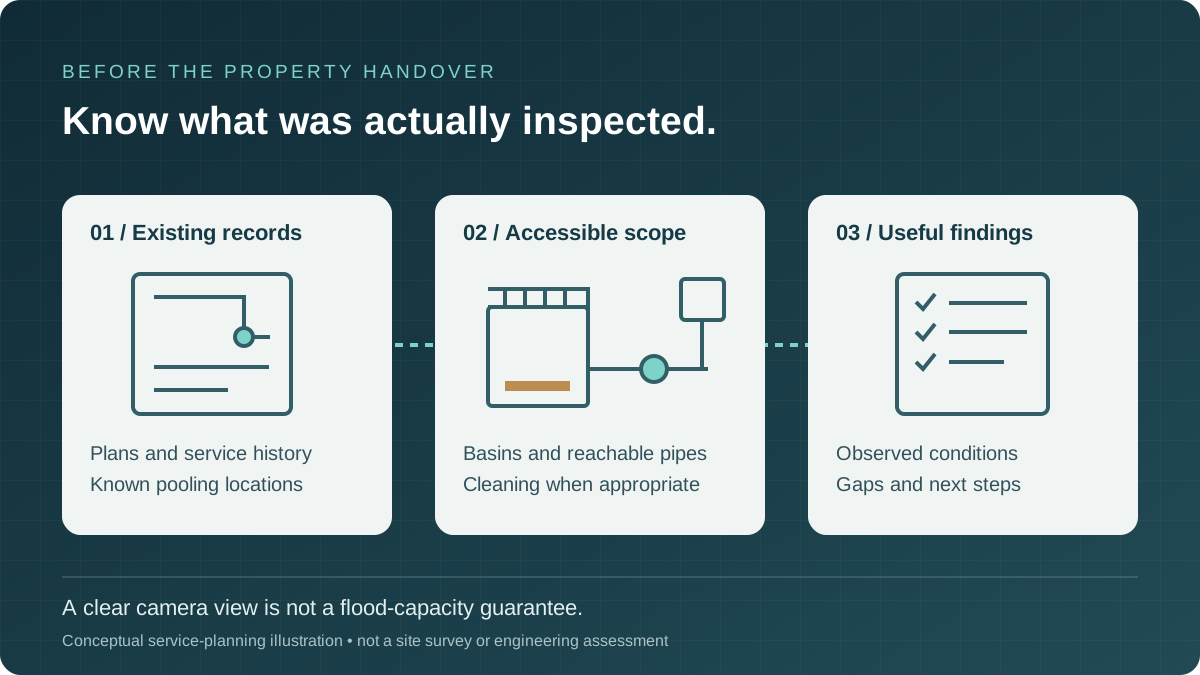
Ask the current owner or property manager for existing drainage plans, recent catch basin cleaning records, previous camera findings and known repeat-pooling locations. These are useful inputs, not proof that every buried connection is accurately mapped or currently sound.
- Which structures were serviced? Look for basin numbers or locations rather than a general invoice description such as “drains cleaned.”
- Was line work included? Vacuum cleaning of a basin is different from flushing a connected line or recording its condition.
- What was not reached? Parked vehicles, sealed covers, inaccessible pipe entries and high water may leave gaps.
- What happened afterward? Ask whether pooling returned, where it occurred and under what rain conditions.
- Who is responsible? Confirm private-property scope and any shared drainage arrangements through the appropriate records and advisers.
For the public/private booking boundary, read whether to contact the city or arrange private drain service. A drain near the property line does not settle ownership or authorize work on municipal infrastructure.
2. Separate catch basin cleaning from storm pipe inspection
Catch basin condition and cleaning
Catch basin cleaning removes accumulated material from the structure. Ask the provider to identify the structures included and record access limitations. Removing sediment may make a pipe entry accessible, but a clean basin is not evidence that the full outlet pipe was inspected.
Camera inspection of reachable lines
Storm drain camera inspection can help document visible conditions inside accessible pipe sections. Confirm which runs can be attempted, where access will be obtained, and whether video, location references and written observations are included. A camera may be unable to pass an obstruction, bend or damaged section; water and debris can obscure the view.
Cleaning to improve access or visibility
If the pipe is obscured or restricted, hydro jetting or line flushing may be appropriate after the provider assesses pipe condition and access. Do not automatically authorize aggressive cleaning of an unknown or damaged line. Agree who can approve additional work, the proposed method and any return visit before it begins.
3. Define the questions the visit cannot answer
A drainage service visit should not be sold as a blanket pass or fail for a property purchase. Ask the provider to distinguish confirmed observations, suspected issues and areas not inspected.
- Flood capacity: a clear pipe does not establish that its size, outlet or downstream network can handle every rainfall event. Engineering review may be needed.
- Surface grading: pooling can involve pavement levels and runoff paths, not just material in a drain.
- Buried routing: an assumed plan connection is not a verified connection. Private-line locating may need a separate scope.
- Other systems: storm drainage, sanitary sewers, foundation drainage and pumped systems are not interchangeable inspection scopes.
- Legal and transaction matters: responsibility, purchase conditions, warranties and compliance questions belong with the relevant qualified advisers. This guide is service-planning information, not legal or engineering advice.
If a defect is identified, request a separate drainage repair assessment where appropriate. Keep the inspection finding distinct from a confirmed repair design, price or schedule.
4. Plan access before the purchase deadline
A buyer's interest in a building is not authorization to open or clean its drains. Arrange permission through the current owner or authorized manager. Give the contractor the actual decision deadline, while allowing for uncertain access, cleaning and follow-up requirements. Do not assume a report can be completed during a single visit.
For occupied properties, identify delivery windows, parking conflicts, vehicle height limits and areas that must remain usable. Equipment suitability and safe staging need confirmation. Share gated-entry requirements initially; arrange sensitive entry credentials securely during follow-up, not in the website form.
Never lift grates, enter a basin or wade into pooled water to obtain inspection photos. Use existing records and safe surface observations. If water is threatening a building now, call to discuss service availability instead of treating it as a routine purchase checklist. Keep people clear of floodwater and electrical hazards; immediate danger warrants emergency services.
5. Request a report that makes the unknowns clear
Before booking, agree what will be provided. A useful record connects the work to identifiable site locations and avoids claiming more coverage than the visit achieved.
- Visit date, identified basins and pipe sections attempted.
- Cleaning completed, separated from inspection or locating work.
- Accessible footage or distance references where available, and the direction of inspection.
- Visible findings, with observations distinguished from suspected causes.
- Sections not reached or not visible, and the reason.
- Recommended next steps, including further assessment where the initial scope is inconclusive.
Use the existing storm-drain maintenance worksheet to organize the handover. It is a planning aid, not a substitute for the contractor's actual findings. If the purchase proceeds, use those findings to scope a commercial drainage maintenance plan rather than automatically repeating the previous interval.
Pre-purchase drainage questions
Is a normal building inspection enough?
Read the inspector's agreement and ask what drainage work is included. Do not assume buried storm lines were camera-inspected simply because the site or building was reviewed. Arrange a separate authorized scope if needed.
Should every drain be cleaned before the inspection?
Not automatically. Start with records, symptoms and accessible inspection points. The provider can explain whether cleaning is needed for access or visibility and what it would cover. Approve that scope separately where it was not included.
Can an inspection guarantee the property will not flood?
No. It documents conditions in the accessible scope at the time of the visit. Rainfall, surface runoff, inaccessible sections and downstream constraints can remain outside that scope.
Scope the visit before you book
Reviewing a commercial property's storm drains?
Tell Lowermainland Catch Basin Service the city, property type, authorization status and decision deadline. We can discuss catch basin cleaning and accessible storm-line inspection in Port Coquitlam, Coquitlam, Burnaby, New Westminster and other listed Lower Mainland areas. Scope, report deliverables and timing must be confirmed.
Start with your name and phone; records and other details can follow.